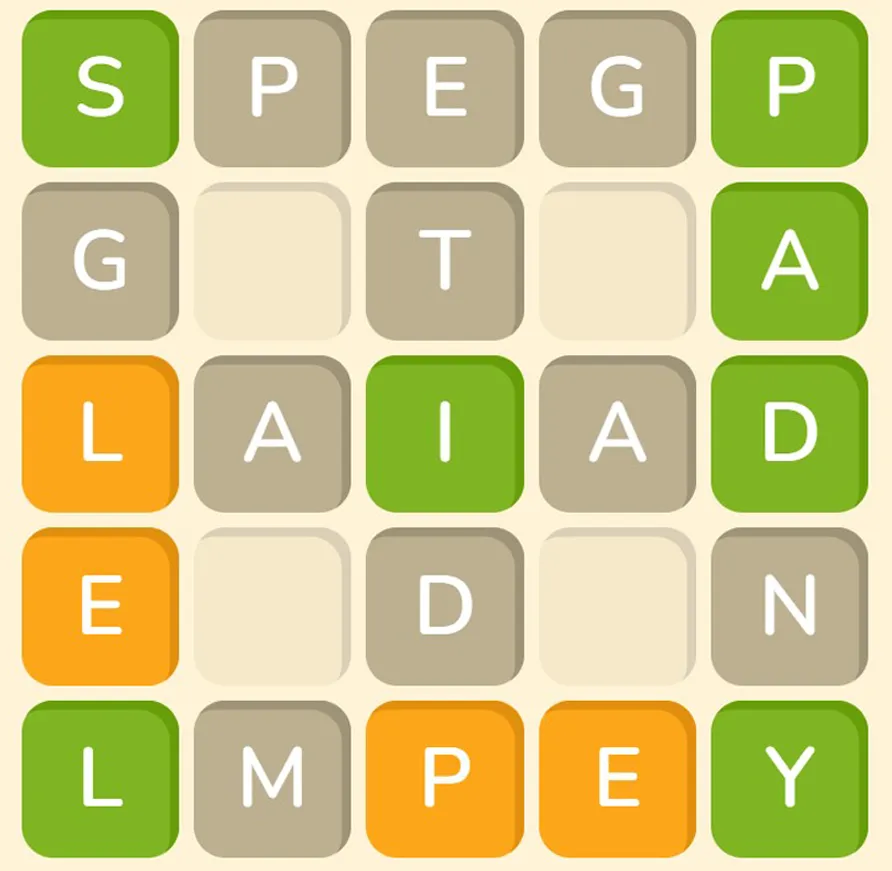
How Waffle Scoring Works: What the Colors Mean
Green means correct position, yellow means correct word but wrong spot, grey means wrong word entirely, reading these three colors correctly is the fastest way to cut your move count.
Every puzzle is built to be solvable in 10 moves or fewer, even though you get up to 15. Solve in exactly 10 or under and you earn a full 5-star rating; each move you don't need above that still gives you a cushion for a wrong guess, not a required buffer.
The color system is also why waffle plays differently from games where you retype a guess from scratch. Because the letters never leave the board, every color change is information that stays useful for the rest of the puzzle, nothing resets. A yellow tile you spot on move 2 is still relevant on move 9, which is a big part of why experienced players solve noticeably faster: they're accumulating clues instead of relearning the grid each turn.
If you have any form of red-green color blindness, this matters more than it might seem, green and yellow are two of the hardest color pairs to tell apart for the most common types of color vision deficiency (deuteranopia and protanopia). Waffle addresses this with an accessibility toggle that swaps the default green/yellow/grey scheme for a higher-contrast palette (typically purple and gold tones), so the color logic still works the same way even if you can't distinguish the standard colors.
Waffle Game Strategy: How to Solve It in Fewer Moves
The single biggest mistake new players make is swapping a letter the moment they spot yellow. That works sometimes, but it burns moves fast on a grid where every letter sits at the intersection of two words, move one letter and you're often changing the color state of a second word you weren't even thinking about.
A Worked Example
Say the center-left position of the grid shows a yellow "A" that's meant to be part of a horizontal word reading _ R A I N. The "A" is one slot to the right of where it needs to be. Before swapping it blindly, check what sits at the intersecting vertical word first, if that vertical word already has a green letter at the same coordinate, moving the "A" there would break a confirmed correct letter, which is never worth it. Instead, look for a second yellow tile within the same horizontal word that the "A" could trade places with. If one exists, that's very likely a two-for-one move: both letters land correctly in a single swap, instead of costing you two separate turns.
That kind of double-check, "what does this move affect in the other direction?", is the difference between solving in 15 moves and solving in 9.
- Lock in green letters first. Treat them as fixed points and build outward instead of re-checking them every move.
- Solve the word with the fewest yellow tiles first. A word that's one swap from complete usually reveals where shared letters belong in the word it crosses.
- Watch the intersections, not just the rows. Center letters belong to both a horizontal and a vertical word at once, fixing one often half-solves the other.
- Hold a couple of moves in reserve. Solving in 9-10 instead of 15 isn't just about the star rating; it gives you room to recover if a swap doesn't land where you expected.
- Think in pairs, not single swaps. Before moving a letter, check whether a different pair of tiles could both land correctly in the same move.
Common Mistakes That Waste Moves
- Moving a green letter "just to check." Green is already confirmed, disturbing it almost always costs a move to undo.
- Solving one word in isolation. Every letter touches two words, so fixating on a single row often creates a new problem in the column it crosses.
- Swapping on a guess instead of a signal. Every move should be responding to a color clue you've already seen, not a hunch.
- Ignoring grey letters. Grey doesn't mean useless, it tells you the letter belongs in the word it crosses, narrowing your options in that direction.
None of this requires memorizing anything; it's pattern recognition that builds up naturally after a few days of play. For a full move-by-move walkthrough of a solved grid, see our complete how-to-play guide.
Waffle Game Modes Compared: Daily vs Unlimited vs Deluxe
All modes share the same core mechanic, swap letters, read the colors, finish before you run out of moves, but they differ enough in grid size and puzzle supply that most players settle into one for daily habit and another for practice.
Waffle Daily Word Game: One New Puzzle Every Day
The daily mode resets once every 24 hours, giving every player the same 5×5 grid and the same six words. Because everyone is working from an identical puzzle, it's the version people actually compare, sharing move counts, star totals, or just bragging about spotting the tricky word faster than a friend did.
- A genuinely new challenge daily, not a repeat or a randomizer
- Shared puzzle means scores are directly comparable
- Short enough for a coffee break, hard enough to be satisfying
- Builds a streak you can track over time
Like most daily word games, the appeal is as much the routine as the puzzle. Players who already work through Wordle each morning often add the waffle daily word game to the same habit, since both reset on a 24-hour cycle and reward the same unhurried style of thinking.
Waffle Unlimited: Play as Many Puzzles as You Want
Waffle unlimited removes the once-a-day restriction entirely, finish one grid and the next is ready immediately, no countdown, no waiting for midnight. Same 15-move ceiling, same six-word target as the daily version; only the puzzle supply changes.
This is the mode most players use when they're first learning to read green, yellow, and grey clues, since repetition is genuinely the fastest way to get fast. A common pattern: warm up with two or three unlimited puzzles, then tackle the daily challenge once the color-reading instinct feels sharp.
Deluxe Waffle: The 7×7 Advanced Challenge
Deluxe waffle scales the whole puzzle up, a 7×7 layout with more words and substantially more intersections to track at once, so a single misjudged swap has a wider ripple effect than it does on the standard grid.
This is where the green-letters-first and intersection-first habits stop being optional. On the small grid you can often muscle through with a couple of extra swaps; on deluxe, planning two or three moves ahead is closer to a requirement. It's built for players who are already comfortable with daily or unlimited mode, not a good starting point if you've never solved a standard grid.
If you're consistently finishing daily puzzles in 9-10 moves with stars to spare, deluxe is the natural next step. If you're still occasionally running out of moves on the standard grid, spend more time in unlimited mode first.
Waffle Challenge: The Timed Competitive Mode
Beyond the three core modes, there's a fourth option worth knowing about: the Waffle Challenge, a 90-second timed mode where the goal isn't finishing one puzzle cleanly but solving as many grids as possible before the clock runs out. Once you make your first swap the timer starts, and you can keep swapping across as many puzzles as you can complete. It's a genuinely different kind of pressure than the daily or unlimited modes, speed matters more than move economy, and it's a good fit for players who've already mastered the standard puzzle and want a different kind of challenge rather than just a bigger grid.
Waffle Game Today & the Puzzle Archive
"Waffle game today" simply means whichever daily puzzle is currently live, it resets on the same 24-hour cycle as the rest of daily mode. If you've solved it and want more, the archive holds previous puzzles so you can revisit ones you missed or replay one you remember being tricky.
Replaying archive puzzles is a low-pressure way to test whether your solving speed has actually improved. You already know the puzzle is solvable in a known move count, so there's no risk of getting stuck on something unsolvable, only the question of whether you can beat your original result.
Why the Waffle Word Game Is So Popular
Word puzzles come and go, but waffle has held a steady, loyal audience for a specific reason: it asks you to think differently than most games it gets compared to. There's no blank screen to fill in and no clue list to decode, just a grid that's almost right, waiting for you to fix it.
It Rewards Logic Over Lucky Guesses
Because every letter is visible from the start, success depends on deduction rather than recall. You're not trying to remember an obscure five-letter word, you're working out where six known words belong, which appeals to people who enjoy logic puzzles and crosswords as much as straight vocabulary games.
Every Puzzle Has a Genuine Solve Path
A well-built waffle grid is solvable through pure color-tracking, read green, yellow, and grey correctly, follow the intersections, and you'll get there. Difficulty comes from complexity, not from unfair guessing.
It Builds a Genuine Daily Habit
The daily mode's 24-hour reset creates the same low-stakes routine that's made other daily word games popular: open it, spend a few focused minutes, close it, come back tomorrow.
It Scales With Your Skill Level
Few word games offer a clean built-in difficulty ladder. Waffle does: start in unlimited mode to learn the mechanics, move to daily for a real test, graduate to deluxe once the standard grid stops being a challenge, and try the Waffle Challenge if you want speed instead of size.
What Playing Waffle Game Regularly Actually Improves
It's easy to overstate the brain-training claims attached to word games, so here's a grounded version: waffle exercises a specific, narrow set of skills, and regular play genuinely sharpens them, it isn't a substitute for broader cognitive training, but within its lane it works.
- Working memory. Tracking which letters are green, yellow, or grey across six words at once means holding several pieces of information simultaneously.
- Pattern recognition. Regular players start recognizing common letter combinations and likely word shapes faster, the same way frequent crossword solvers do.
- Forward planning. Limited moves reward thinking two or three swaps ahead rather than reacting one at a time.
- Vocabulary exposure. Regular solving exposes you to words you might not use daily, reinforcing spelling and word recognition over time.
These are the same general skills crosswords and other logic games target, which is part of why waffle tends to appeal to people who already enjoy that category, a genre game wearing a fresh format, not a wholly new kind of mental exercise.
Is Waffle Game Made by The New York Times?
No. Waffle is not an official New York Times property, it was created independently by James Robinson and is run by his studio, Waffle Studio. The confusion is understandable: Wordle was also independently built before NYT acquired it in 2022, and Waffle borrows the same daily-puzzle, color-coded-feedback format that made Wordle popular. But the two games are built and operated completely separately, even though they're often searched together as "nyt waffle."
If you're coming from Wordle, the core difference is simple: Wordle has you typing guesses for one hidden word with no letters shown in advance. Waffle gives you every letter you'll need right from the start, scrambled across six intersecting words, and asks you to rearrange rather than guess. Wordle rewards vocabulary recall; waffle rewards spatial logic and planning, which is why a lot of players enjoy both for different reasons.
Waffle Game vs Other Word Puzzles
- Waffle Game vs. Crossword puzzles: Crosswords use clues to fill blank spaces; waffle gives you the letters but scrambles their placement, so there's no clue list to lean on, only color feedback.
- Waffle Game vs. Word scrambles: A standard scramble usually involves one word at a time. Waffle's grid means every move affects two words simultaneously, which is what makes it feel closer to a logic puzzle than a simple unscramble task.
That combination, visible letters, no clues, two-directional words, built by an independent developer rather than a major puzzle publisher, is the specific reason waffle carved out its own niche instead of being treated as just another Wordle clone.
Who the Waffle Game Is Right For
Waffle's rules are simple enough to explain in under a minute, but the difficulty ceiling, especially in deluxe mode, stays interesting for experienced solvers. That range is what makes it work across a fairly wide audience:
- Beginners and casual players can learn the color system in one or two puzzles and start solving comfortably within their first week.
- Crossword and Wordle regulars pick it up quickly since the core logic, using feedback to narrow possibilities, is familiar territory.
- Students and younger players get genuine vocabulary and spelling reinforcement without the format feeling like schoolwork.
- Players with color vision deficiency can use the built-in accessibility color scheme to read the same clues without relying on the default green/yellow contrast.
- Puzzle enthusiasts looking for a harder challenge have a clear next step in deluxe mode or the timed Waffle Challenge once the standard grid stops being difficult.
No account, download, or age-gated content is involved. The game runs entirely in the browser on desktop and mobile, which keeps the barrier to trying it about as low as it can get.